How to make your cat dance from one photo
Choose between the wizard-hat Buggin dance and the basket-carrying Cat Bridge Dance, prepare a useful full-body photo and judge the motion before posting.
To make your cat dance from one photo, choose the Buggin Dance or Cat Bridge Dance template, upload a clear full-body cat photo and enable audio if you want its fixed soundtrack. Your photo guides the cat's appearance; the selected template supplies the routine, costume and setting.
Choose the dance before choosing the photograph. That order saves a surprising amount of guesswork. A wizard-hat paw groove and a basket-carrying bridge routine are not interchangeable scenes, even though both begin with one cat photo.
Our Buggin Dance and Cat Bridge Dance templates use fixed video references. Your upload guides the performer’s appearance; the reference guides the setting, costume and motion. You do not need to film your cat standing upright, and the page does not accept an arbitrary dance clip as a custom reference upload.
Choose a routine for the joke you want to tell
The She Bugging routine has a wizard hat, moonlit setting, salute, chest-height paw groove and turn. It suits a cat with a very serious personality doing something much too theatrical. The current template follows an opening excerpt, so it is a poor choice if you need every move from the longer reference.
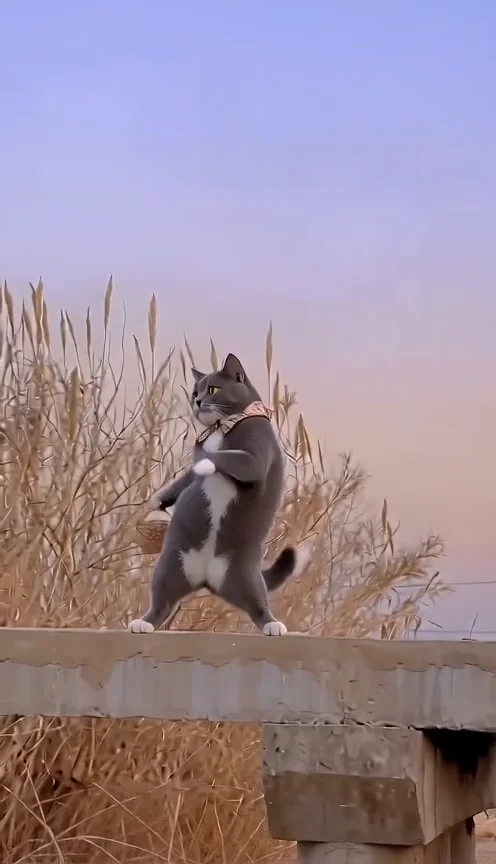
The bridge routine puts the cat in a headscarf with a little basket on a narrow concrete bridge beside reeds. The cat looks as though it has paused an errand to perform. It works with captions about shopping, taking the long way home or getting distracted halfway through a task.
Cat Bridge Dance AI is our descriptive name for the linked Douyin scene. We have not verified that it has a fixed English TikTok name. It should not be confused with the frozen Han River cat dance or assumed to be connected to Irish Riverdance simply because a bridge or river appears in the picture.
A full-body photo is useful even when the face matters most
Look for an ordinary, sharp image with the face, ears and paws visible. A relaxed standing cat gives a readable outline. A sitting cat can still offer useful identity and body information. A curled-up sleeping pose leaves much more of the body for the model to invent, while a very tight face crop says little about the limbs that will carry the dance.
Do not crop directly through the ears or paws. Leave a little room around long fur, and remove other animals from the frame. A plain background can make the outline easier to read, but you do not need to photograph the cat in the final location. The moonlit beach or bridge comes from the template, not from your living room.
Avoid solving an input problem by adding more accessories. A hat, costume or blanket in the source photo can hide the markings that make the cat recognizable. The reference already supplies a costume. Choose the picture that tells you most clearly which cat it is.
What does a reference video actually control?
A reference gives the generation a concrete sequence to follow: the order of gestures, the camera angle, the character’s movement and the objects in the scene. This is why a template can produce a more recognizable remix than a broad instruction to “make a funny dancing cat.” The desired performance is defined before you upload.
It is still generated video. The model rebuilds the cat through changing views and contact with props. It may borrow a rounded body shape from the reference, soften markings during a turn or change how a paw meets a basket handle. Motion guidance is not the same as copying every source frame while replacing only the face.
That difference also explains why a good first frame is insufficient. A model can draw a convincing cat in a hat and then lose its features halfway through a spin. The result to judge is the whole moving performance, including the least flattering frame.
Watch the paws, turns and props before sharing
Play the output at normal speed once, then pay attention to the hardest moments. In the wizard routine, those are the turn and kick. In the bridge routine, watch the basket near the paws and the cat’s outline as it rotates. Look for an extra limb, a sudden coat change or an object that appears to float away.
Our published examples show reviewed gray-and-white cat results, with sound added after video generation. They are useful comparisons, not a success-rate study across breeds and photo conditions. Neither template currently offers a two-cat version, and a dog has not been validated for these specific performances.
What do our two cat-dance samples demonstrate?
In the Buggin sample, a rounded gray-and-white cat wears a pointed wizard hat by the water at night, raises its paws and moves into the turning routine. In the bridge sample, a gray-and-white cat wears a headscarf and carries a basket while changing direction on the narrow bridge. The costumes, props and surroundings make these two results easy to tell apart even though the performers have similar colouring.
Our generated Buggin example, with the fixed soundtrack added after generation. The source linked on the template page is a TikTok repost by @memescreens.
The useful comparison: choose Buggin for the wizard-hat paw routine and Cat Bridge Dance for the basket-carrying errand joke. Both sample downloads contain audio tracks, but neither demonstrates a custom-song upload, a two-cat cast or exact preservation of every marking through a fast turn. Watch the bridge sample and its source notes alongside this one to choose the scene before spending.
Should I change the photo or generate another take?
If the face is wrong from the opening, revisit the source photo. If only one fast movement is imperfect, decide whether it is acceptable at normal playback speed before spending on a new take. Do not repeatedly regenerate a result that you have only viewed as a frozen thumbnail.
Keep the sound attached to the dance
A gesture can feel late when its soundtrack has shifted, even if the motion itself is plausible. Enable audio if you want the template’s fixed track, and check the final file through to the end. If you trim away the opening, listen again after the edit; you may have removed the beat that set up the salute or the first step.
A muted preview does not necessarily mean the download has no audio. The sound troubleshooting guide explains how to separate playback settings, unfinished composition and a genuinely silent file. Check those before buying another video to solve an audio-only problem.
Give the dance a reason to exist
“Reporting for the midnight shift” needs the wizard salute. “Sent out for groceries” needs the basket. Those small connections make a caption feel attached to the scene instead of pasted onto any animal video. For a pet account, use the cat’s familiar habits rather than narrating each step.
Keep text clear of the paws and props. Leave enough of the opening for someone unfamiliar with the original to understand what is happening, and share the result as an AI pet remix. If you would rather have the cat deliver a greeting than perform a full-body routine, make a birthday singing-cat clip instead.