How to make a two-person AI meme without mixing up the roles
Plan two-person photo roles for the elevator prank and group dances, avoid ambiguous group uploads, and check face consistency when the cast moves.
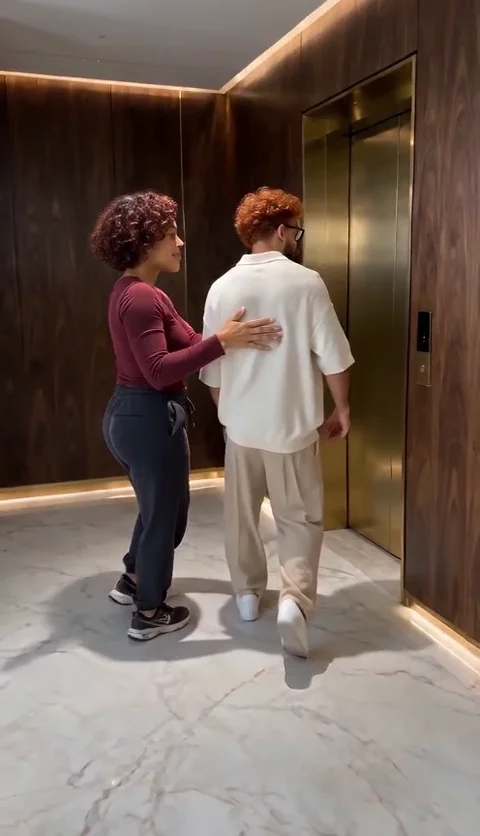
To make a two-person AI meme, select the two-person version first and upload one clear individual photo into each labelled role. In Dog Elevator Prank's Two friends version, photo one becomes the human prankster and photo two becomes the victim; the original dog is replaced. Choose You and the dog instead if you want the dog to remain.
A two-person AI meme starts with a casting decision: who does what? Two excellent portraits can still produce the wrong joke if they go into the wrong slots. Decide who should play the prankster, victim or lead dancer before uploading either photo.
The clearest example is Dog Elevator Prank. In its Two friends version, the first photo becomes the human prankster who takes over the dog’s role, and the second becomes the victim. In You and the dog, there is one human upload and the golden retriever remains. “Two-person” and “me with the dog” are different versions, not different descriptions of the same input.
Write the cast in one sentence
Before you open the upload panel, finish a sentence such as “Alex plays the prankster and Sam gets sent into the lift.” That sentence is enough to prevent many avoidable mistakes. It also tells you which sample to inspect and whose face should appear during each action.
A dance needs a slightly different decision. The OG Christmas Dance has solo, duo and trio versions, while Chipmunks Dance offers duo and trio. Select the cast size first. An extra face visible in one uploaded picture does not add a supported performer to the template.
For a trio, assign one person to each slot instead of treating the uploads as a loose reference collection. The model needs a useful identity for every role. Two people sharing a surname or wearing the same outfit does not make their photos interchangeable.
Use separate photos with one intended face each
Separate portraits remove a selection problem. A group picture asks the model to infer not only a face but also which face belongs to a specific role. If the upload contains three friends and only one is intended, crop to that person before submitting it.
Keep enough resolution for the face to remain clear after cropping. A small face in a distant wedding photograph can become a blurry portrait when enlarged. If another hand or shoulder crosses the face, choose a different photo rather than assuming the model can reconstruct the hidden features accurately.
Comparable lighting and reasonably similar camera angles help you judge the cast together. You do not need identical backgrounds or a staged photo shoot. A sharp front or three-quarter view is generally easier to interpret than one extreme profile paired with a face hidden by sunglasses.
What if the result swaps the people?
First check the selected version and slot order. In the two-friend elevator scene, the first person should replace the original dog with a fully human prankster. A viewer expecting the dog to stay may think this is a failed replacement, even when it matches the chosen version. If you want yourself beside the dog, select the one-photo version instead.
If the slots are correct but faces change as the clip moves, you are seeing a different issue: identity drift. Reference-guided generation rebuilds people over time. It is not a promise that two original faces will be pasted perfectly onto every frame of the source video.
Watch the moments where the performers turn away, overlap or pass close to the camera. A face can look correct at the start and change after it reappears. Clothing can also migrate between characters. Those are reasons to review the full sequence, not to judge a group result from its opening poster.
Why do group dances need a different review?
In the elevator prank, the roles have a narrative: one person initiates the gag and the other reacts. In a dance, the model must maintain several bodies while they repeat similar movements. Overlapping arms, a lead change and a final approach to the camera can make the identities harder to separate.
The Chipmunks-style dance guide explains why the formation and lead change matter to the format. Check that the right number of people remains on screen and that each dancer returns with the same face after a turn. “The group looks energetic” is not a substitute for checking who is actually in it.
A trio is not automatically a better choice than a duo. If the joke is about two friends, a third performer adds complexity without helping the story. Choose the smallest cast that makes the idea work.
A clear sample can save an unnecessary generation
Before paying, compare the sample for the exact version you selected. Our elevator page separates the original reference from the generated two-friend and one-person examples. The two-friend sample was made with Mini; the existing one-person sample was made with Seedance 2. Those are reviewed examples from their actual runs, not identical tests across every model.
The Two friends sample shows two human performers: a burgundy-clad prankster and a white-clad victim beside the gold lift. The victim removes the shoes and ends up inside the lift while the prankster handles the shoe gag. In the other sample, an upright golden retriever performs the prank beside a human victim. That visible difference is the reason to choose a version before assigning the uploads.
Our Two friends elevator sample: two human roles, generated with Mini and an added soundtrack.
What the examples establish: the site has separate demonstrated scenes for two humans and for a human with the retained dog. They do not establish that either model keeps every face unchanged through turns, or that Mini and Seedance 2 performed equally in a controlled comparison. Use the samples to select the cast and action, then check your own result for identity.
Check the selected cost and audio before retrying
Check the displayed cost and settings after selecting a version. Do not infer the charge from another template or an old article. If the finished picture is acceptable but the sound is missing, follow the audio checks before generating the visuals again. A soundtrack problem does not automatically require a new cast performance.
Make the caption fit the roles
“Never let Alex press the lift button” gives the prankster a purpose. “Us after agreeing to buy one decoration” makes a Christmas duo about a shared habit. For a lead-changing group dance, a line about everyone wanting to run the meeting matches what the cast is actually doing.
Use people’s photos with their permission, particularly when the joke puts someone in the victim role. Present the clip as a playful AI scene rather than evidence that an event happened. A convincing-looking lift lobby or phone-camera angle makes that small distinction useful when the video leaves the original group chat.